

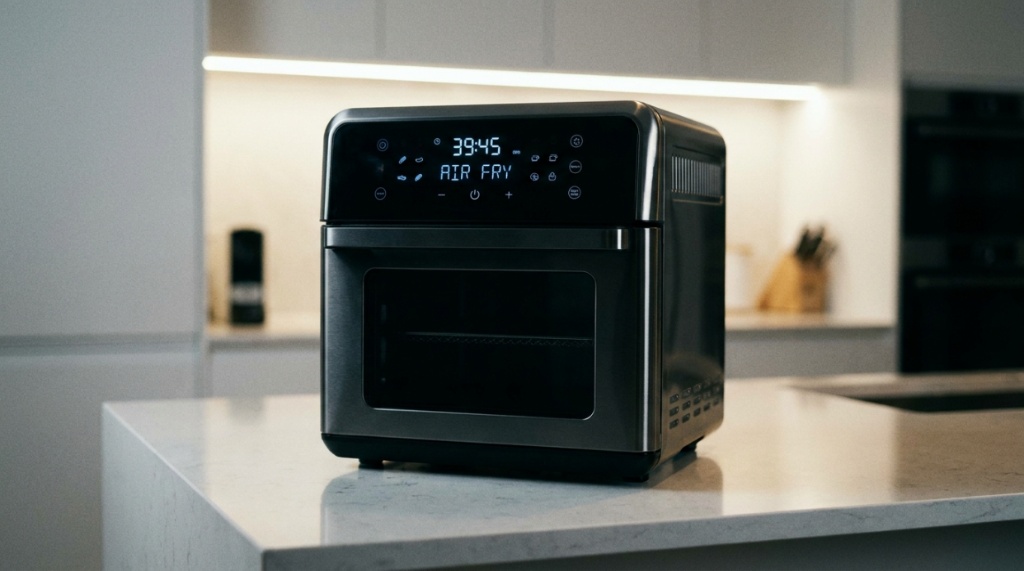
The typical American family uses their full-size oven for about 45 minutes to prepare a meal, while a smart air fryer oven can accomplish the same task in just 22 minutes, using 60% less electricity. However, many buyers focus on capacity and price when selecting an air fryer, often neglecting to consider the energy specifications that truly reflect savings. To find a smart air fryer oven that effectively saves both time and energy, it’s essential to assess key performance metrics: preheat speed, watt-per-hour consumption, cooking time reduction compared to traditional methods, and smart automation features that minimize wasted energy during idle heating.
A smart air fryer oven is a sophisticated countertop appliance that utilizes rapid convection air circulation and connected technology—leveraging WiFi, app controls, and algorithmic cooking programs to enhance cooking efficiency and energy use beyond what manual methods can achieve. A common mistake among buyers is assuming that all air fryer ovens provide the same energy savings, which is not the case. For instance, a poorly designed 1800W air fryer that requires 10 minutes to preheat and cooks unevenly may use more energy per meal than a well-constructed 1500W model that preheats in just 2 minutes and cooks evenly from the start. This guide will highlight the specific features that distinguish genuinely energy-efficient air fryers from those that are simply marketed as such.
How Much Energy Does a Smart Air Fryer Oven Actually Save?
A quality smart air fryer oven saves 40–70% energy per meal compared to a conventional full-size oven — primarily through faster preheat (2–5 minutes vs 10–15), shorter cook times (25–40% faster), and smaller heating volume (heating 1 cubic foot vs 5 cubic feet of air).
Energy comparison data:
| Appliance | Average Wattage | Preheat Time | Cook Time (chicken breast) | Total Energy Used | Cost Per Meal* |
|---|---|---|---|---|---|
| Conventional oven | 3000–5000W | 10–15 min | 25–35 min | 1.8–2.5 kWh | $0.27–$0.38 |
| Standard air fryer oven | 1500–1800W | 3–5 min | 15–22 min | 0.5–0.7 kWh | $0.07–$0.10 |
| Smart air fryer oven (optimized) | 1400–1800W | 2–4 min | 12–20 min | 0.4–0.6 kWh | $0.06–$0.09 |
*Based on average US electricity rate of $0.15/kWh
Annual savings calculation: cooking 2 meals daily in a smart air fryer oven versus a conventional oven saves approximately $130–$210 in energy costs annually. For a $300 smart air fryer oven, energy savings alone provide full payback within 18–28 months — before factoring time savings value.
The smart advantage over standard air fryers: intelligent models save an additional 10–15% energy through auto-shutoff at target doneness (preventing overcooking), optimized element cycling (heating elements pulse rather than run continuously), and multi-step programs that adjust power during cooking phases rather than maintaining maximum wattage throughout.
What Features Make a Smart Air Fryer Oven Genuinely Time-Saving?
The features that create measurable daily time savings are: instant/rapid preheat technology, internal temperature probes with auto-shutoff, app-based scheduling from anywhere, and algorithmic cook programs that calculate optimal time and temperature without manual input.
Feature-by-feature time savings analysis:
- Rapid preheat (saves 8–12 minutes vs conventional oven): Smart air fryer ovens reach cooking temperature in 2–5 minutes versus 10–15 minutes for conventional ovens. This isn’t a minor convenience — it’s 8–12 minutes recovered every single meal that previously disappeared as waiting time. Models with infrared pre-heating (Brava) reach temperature nearly instantly.
- Temperature probe auto-shutoff (saves 5–15 minutes/meal): Meat reaches exact target internal temperature and the oven stops automatically. Eliminates: repeatedly checking doneness, cutting into food to test, overcooking from guessing, and the mental burden of timing. You insert probe, press start, and walk away with confidence.
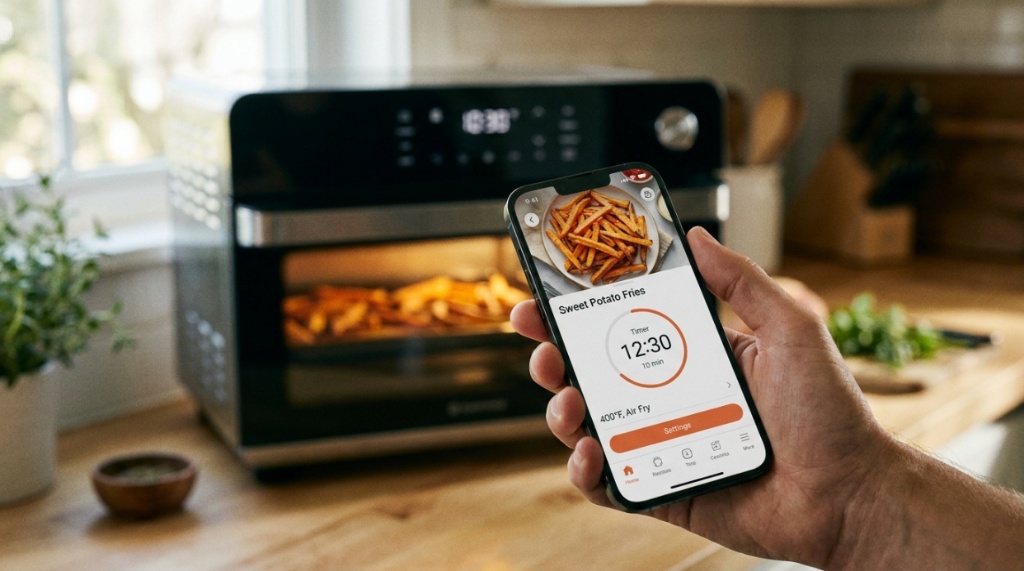
- Remote preheat/scheduling (saves 5–10 minutes/meal): Start preheating from your phone while driving home, finishing work, or handling other tasks. Oven is ready the moment you enter the kitchen — converting dead preheat waiting time into productive time elsewhere.
- Guided cook programs (saves 3–8 minutes/meal): Input food type and weight. The oven calculates time and temperature — eliminating recipe searching, mental math, and temperature conversion. One decision replaces five.
- Multi-zone cooking (saves 15–30 minutes/meal): Premium models cook different foods at different temperatures simultaneously (protein on one rack, vegetables on another). This eliminates sequential cooking where you wait for one item to finish before starting the next.
Cumulative daily time recovery: a well-featured smart air fryer oven saves 20–45 minutes per meal for a family cooking twice daily at home. That’s 4.5–10.5 hours weekly — equivalent to recovering an entire workday per week in practical time that traditional cooking methods consume.
How Do You Evaluate Energy Efficiency Before Purchasing?
Evaluate energy efficiency by checking three metrics: wattage-to-capacity ratio (watts per quart of cooking space), stated preheat time, and whether the oven uses pulsed element cycling or continuous heating — with pulsed models using 15–25% less energy for identical results.
Efficiency evaluation checklist:
- Wattage-to-capacity ratio: Divide wattage by interior quart capacity. Efficient ratio: 60–75 watts per quart. Inefficient ratio: 90+ watts per quart. A 1500W, 25-quart oven (60W/quart) is more efficient than a 1800W, 15-quart oven (120W/quart) — heating more food with proportionally less energy.
- Preheat time (published vs. real): Check user reviews for actual preheat times, not manufacturer claims. Some ovens advertise “no preheat needed” but produce uneven results without it. Others claim 3-minute preheat but actually need 5–7 minutes to reach stable temperature. Real preheat time determines real energy consumption before cooking even begins.
- Element cycling technology: Advanced models cycle heating elements on and off rapidly (pulsing) to maintain temperature without continuous max-power consumption. Look for terms like “Element IQ” (Breville), “smart heat management,” or “precision temperature control.” Continuous-on elements waste energy overshooting target temperature then waiting for cool-down.
- Insulation quality: Well-insulated ovens retain heat better — requiring less energy to maintain temperature during cooking. Touch the exterior during operation: warm is normal, hot indicates poor insulation and energy waste. Double-wall construction retains heat better than single-wall.
- Auto-shutoff intelligence: Ovens that stop heating the moment food reaches target temperature (probe-based) waste zero energy on overcooking. Models without this feature continue heating until a timer expires — potentially wasting 5–10 minutes of energy on food that was done earlier.
Which Smart Air Fryer Ovens Offer the Best Energy Efficiency?
The most energy-efficient smart air fryer ovens currently available are the Breville Joule Oven Air (Element IQ pulsing technology), Cosori Smart Air Fryer Oven (optimized watt-to-capacity ratio), and Brava (infrared heating that reaches temperature instantly with zero preheat waste).
Efficiency comparison of top models:
- Brava ($400–$600): Uses pure infrared light instead of traditional elements — reaching full cooking temperature in under 1 minute (virtually zero preheat energy waste). Zone cooking capability means you only heat areas where food is placed. Most energy-efficient technology available, though premium pricing limits accessibility.
- Breville Joule Oven Air ($350–$500): Element IQ individually controls 5 heating elements, activating only those needed for the current cooking stage. Pulsed operation maintains precise temperature without continuous max power. Superb insulation reduces heat loss. Best efficiency at this capacity class (21L).
- Cosori Smart 30L ($180–$250): Excellent watt-to-capacity ratio (1800W across 30 quarts = 60W/quart). Dual heating elements with intelligent cycling. Fast 3-minute preheat. Best efficiency per dollar spent — delivering premium efficiency metrics at mid-range pricing.
- Ninja Foodi Smart XL ($200–$300): TrueSurround technology distributes heat efficiently. Probe thermometer prevents energy waste from overcooking. Quick preheat (3–4 minutes). Not the most efficient single metric, but strong overall efficiency with maximum versatility.
How Much Time Does Smart Automation Actually Save Weekly?
For a household cooking 10–14 meals per week at home, smart air fryer oven automation saves 3.5–7 hours weekly through eliminated preheat waiting, removed monitoring time, faster cooking completion, and reduced cleanup from contained cooking splatter.
Weekly time savings breakdown (based on 12 home-cooked meals/week):
- Preheat time eliminated: 12 meals × 8 min saved = 96 minutes/week
- Cook time reduction (30% faster): 12 meals × 10 min saved = 120 minutes/week
- Monitoring/checking eliminated: 12 meals × 5 min saved = 60 minutes/week
- Remote start convenience: 5 instances × 5 min = 25 minutes/week
- Cleanup reduction (less splatter, easier surfaces): 12 meals × 3 min = 36 minutes/week
- Total: approximately 337 minutes (5.6 hours) saved weekly
This calculation is conservative — it doesn’t account for the mental burden reduction of not tracking cooking times, not researching temperatures, and not worrying about overcooking. The cognitive load elimination is harder to quantify but meaningfully improves the cooking experience beyond measurable minutes.
What Should You Avoid When Shopping for Energy Efficiency?
Avoid ovens with continuous-on-only elements, models requiring extended preheat despite marketing claims, oversized ovens for small-household cooking (heating unnecessary volume), and “smart” features that require the app to do basic operations the oven should handle independently.
Red flags that indicate poor efficiency:
- “No preheat needed” claims with poor user reviews: Some ovens skip preheat but produce unevenly cooked food — forcing extended cook times or second attempts that waste more energy than a proper preheat would have used. Verify claims against real user results.
- Single heating element with “convection” label: A single top element with a fan is technically convection — but it heats inefficiently from one direction only, requiring longer times or manual flipping. Dual elements (top + bottom) cook faster and more evenly = less energy wasted per meal.
- Oversized for your needs: A 30-quart oven heating a single chicken breast wastes energy heating 25 quarts of empty air. Match capacity to your typical meal size. Cooking at 60%+ capacity is efficient; cooking at 20% capacity wastes proportional energy.
- Poor insulation (hot exterior): If the exterior becomes dangerously hot during use, significant thermal energy is escaping — energy your food should be absorbing. This also heats your kitchen, potentially triggering AC use that compounds energy waste.
- No auto-shutoff at completion: Models that simply beep when the timer expires but keep heating until you manually turn them off waste energy and overcook food. Smart shutoff (element power cuts at target temperature or timer end) is essential for efficiency.
One of the biggest perks of upgrading to a modern countertop appliance is how evenly it distributes heat. For example, if you want a rich, bubbly baked pasta dish without firing up your large range, you can easily use your new appliance to Build the Ultimate Mac and Cheese Using Wisconsin Cheddar. The smart oven’s convection fans create that coveted, crispy golden crust on top while keeping the premium cheese sauce perfectly gooey underneath.
Conclusion
A genuinely time-saving and energy-efficient smart air fryer oven combines rapid preheat (under 5 minutes), intelligent element cycling, temperature probe automation, and meaningful app features that eliminate manual intervention — collectively saving 4–7 hours weekly and $130–$210 annually in energy costs for regular home cooks. The technology premium ($200–$400 over basic models) pays for itself through reduced utility bills within 1–2 years while simultaneously reclaiming hours of weekly time that conventional cooking methods consume.
Evaluate efficiency through specific metrics: wattage-to-capacity ratio, real preheat times from user reviews, element cycling technology, and auto-shutoff intelligence. Choose brands with proven efficiency engineering (Breville, Brava, Cosori) over generic models that prioritise capacity over cooking optimisation. The smartest air fryer oven isn’t the biggest or the cheapest—it’s the one that cooks your specific meals faster, with less energy, and with less of your attention required throughout the process.
Frequently Asked Questions
Do smart air fryer ovens really use less electricity than regular ovens?
Yes — measurably. A smart air fryer oven uses 0.4–0.7 kWh per meal versus 1.8–2.5 kWh for a conventional oven cooking the same food. This 60–75% reduction comes from a smaller heating volume, faster preheat, shorter cooking duration, and intelligent power management. Annual savings of $130–$210 for daily-use households are well-documented across consumer energy studies.
How fast does a smart air fryer oven preheat?
Most quality smart air fryer ovens preheat in 2–5 minutes. Infrared models (Brava) reach temperature in under 60 seconds. Compare this to conventional ovens (10–15 minutes), and the time/energy savings become immediately apparent. Preheat speed is directly correlated with energy efficiency—shorter preheat = less wasted energy before cooking begins.
Is a smart air fryer oven faster than a microwave?
For reheating: microwaves remain faster (30 seconds–3 minutes vs. 3–8 minutes in air fryer oven). For cooking from raw: smart air fryer ovens are competitive with or faster than microwaves while producing dramatically better food quality (crispy textures, browned surfaces, even cooking). The air fryer oven replaces conventional oven cooking time, not microwave convenience—while offering far superior results to microwave cooking.
Do smart features actually reduce cooking time or just add convenience?
Both. Smart scheduling and remote start add pure convenience (no waiting). But algorithmic cooking programs genuinely reduce cooking time by calculating optimal temperature-time combinations that cook faster than default human-selected settings. Temperature probes prevent overcooking (which is wasted time on food already done). Combined, smart features deliver measurable time reduction beyond simple convenience.
Which is more energy efficient: an air fryer basket or an air fryer oven?
For small portions (1–2 servings), basket-style air fryers are slightly more efficient due to smaller heating volume. For family-size portions (3+ servings), air fryer ovens are more efficient because they cook full meals in one cycle rather than requiring multiple small batches. The crossover point is approximately 3 servings—above this, oven-style wins on efficiency per serving.
How long does a smart air fryer oven last with daily use?
Quality models (Breville, Ninja, Cosori at $200+) typically last 3–5 years of daily use. Heating elements average 3,000–5,000 hours of operation before degradation. Daily use (1 hour/day) provides approximately 3.5–5.5 years before element replacement might be needed. Fans and electronics generally outlast elements when properly maintained (regular cleaning prevents overheating from grease buildup).


