

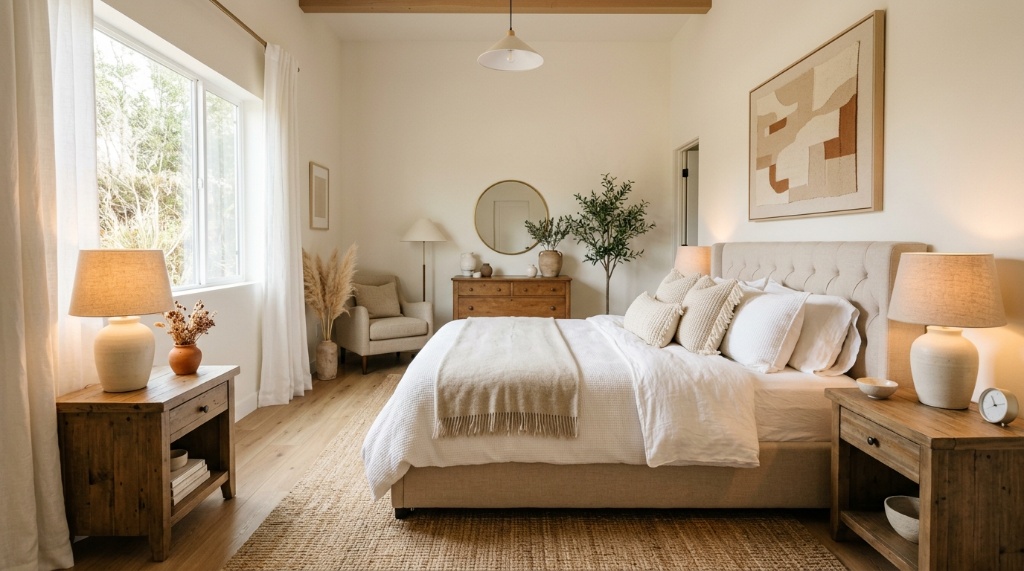
A neutral bedroom sounds effortless on paper: pick a soft paint color, add white bedding, done. Then you finish the room and it feels more like a hotel lobby than a place you want to sink into. The problem is rarely the color — it’s the missing layers. Neutrals only feel cozy when texture, contrast, and lighting do the work that color normally would. The quickest place to start is at pillow level, where something like stylish grey faux fur cushions can break up an otherwise flat expanse of fabric. This guide walks through the build order, from base layers to final details, so the result feels deliberate rather than assembled.
Quick Answer
Build a cozy neutral bedroom from the bottom up: choose a warm-toned neutral base for walls and bedding, layer in texture through textiles, add warm lighting at three heights, and finish with cushions and throws. The single most important rule is texture contrast — a room where every surface is matte, smooth, and flat will read cold no matter how warm the paint color is. Coziness comes from variation, not from color alone.
Key Takeaways
- Warm neutrals (cream, oatmeal, greige, mushroom) feel cozier than cool greys with blue undertones, especially in rooms with limited natural light.
- Texture contrast matters more than color variety — mix matte, plush, nubby, and slightly shiny fabrics in the same palette.
- Lighting temperature does more for coziness than any single purchase; warm bulbs around 2700K on dimmers outperform bright cool-white overheads.
- Cushions are the cheapest, most reversible way to add texture and depth, so treat them as the finishing layer rather than the starting point.
- Build in order — base, texture, light, accents — because buying accent pieces first usually leads to a mismatched room.
Start With the Base Layers, Not the Decor
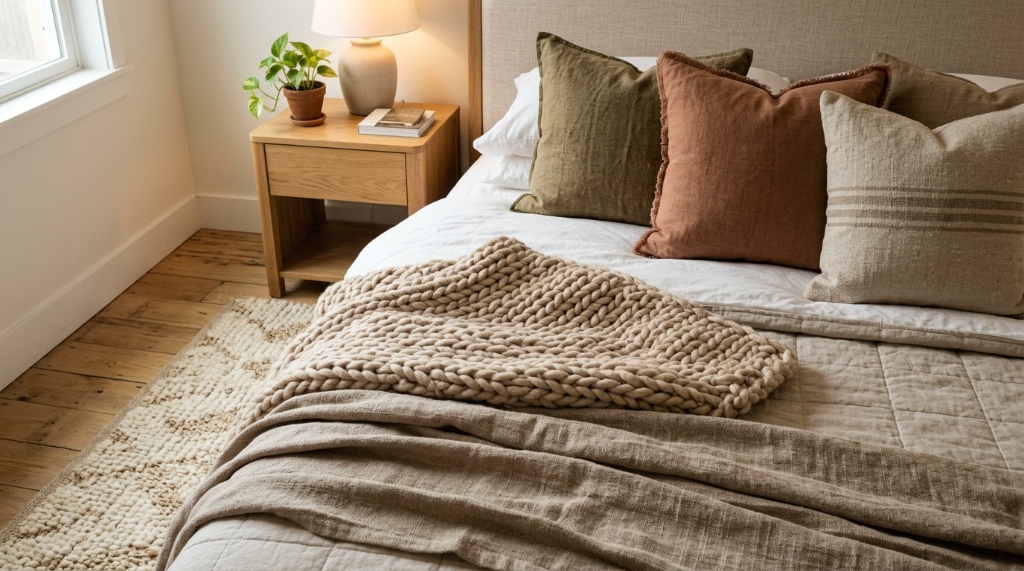
The foundation of a cozy neutral bedroom is the combination of wall color, flooring, and bedding. These cover the largest surface area, so their undertone sets the emotional temperature of the whole room. Get this wrong and no amount of cushions will fix it.
Warm neutrals vs. cool neutrals
Neutrals are not a single category. Warm neutrals lean yellow, red, or brown — cream, ivory, oatmeal, sand, greige, mushroom, taupe. Cool neutrals lean blue, green, or violet — dove grey, slate, cool white, charcoal. Both can work, but warm neutrals reflect light in a way that reads softer and more enveloping, which is why they dominate cozy interiors.
Cool neutrals can absolutely feel cozy, but they need more help. If you prefer grey walls, compensate with plush textiles, warm wood tones, and warm lighting. Without those counterweights, cool grey tends to look clinical.
Test paint in your actual room
Paint chips look different under store lighting than they do in a bedroom, and different again at night. Paint a large sample — at least A3 size — on two walls, then check it in morning light, afternoon light, and with your lamps on. Undertones that look subtle on a small chip become obvious across a full wall.
Bedding as the base, not the accent
White bedding is the default neutral choice, and it works — but pure optic white can feel stark against warm walls. Off-white, ivory, or a soft oatmeal duvet usually sits better in a cozy scheme. Choose a mid-weight fabric with a little texture, such as washed linen or a cotton-linen blend, rather than a slick sateen. The fabric’s hand matters as much as its color.
Choose a Three-Tone Palette Instead of One Color
A single neutral across walls, bedding, and furniture creates a flat, unanchored room. The fix is a simple three-tone structure: one light, one mid, one dark. For example, cream walls, oatmeal bedding, and a mushroom or charcoal element like a headboard, bench, or rug.
The dark tone is the one people skip, and it’s the one that makes the room feel finished. Without a darker anchor, the eye has nowhere to rest and the space reads as unfinished rather than minimal. You don’t need much — a dark wood nightstand or a deep-toned throw can be enough.
Keep the palette to three tones plus one accent. More than that and the room starts to feel busy, which defeats the purpose of a neutral scheme.
Layer Texture to Do the Work Color Normally Would
This is the step that separates a cozy neutral bedroom from a cold one. In a room without color contrast, texture contrast becomes the primary visual interest. Aim to include at least four different texture types.
- Matte and slightly rough: washed linen, cotton canvas, wool, jute
- Plush and high-pile: faux fur, sheepskin, velvet, chenille
- Nubby and dimensional: boucle, chunky knit, waffle weave
- Subtly reflective: sateen, silk blends, brushed metal, glass
The reflective category is the one most people forget, and it’s what stops a neutral room from looking dusty. A small amount of sheen — a satin pillowcase, a glass lamp base, a mirrored tray — adds depth without adding color.
Where to place each texture
Put rougher, matte textures on large surfaces: the rug, the duvet, the curtains. Put plush textures where you actually touch them: cushions, a throw at the foot of the bed, a small sheepskin on a chair. Put reflective accents high and small, where they catch light without dominating.
Cushions and Pillows: Where the Room Gets Its Personality
Cushions are the most efficient layer in the whole room. They’re inexpensive relative to furniture, easy to swap, and they sit at eye level when you walk in. They’re also where texture mixing becomes visible rather than theoretical.
How many cushions actually work on a bed
Three to five is the practical range for most beds. A reliable arrangement is two large square cushions at the back, two mid-size squares in front, and one lumbar cushion at the very front. Odd numbers tend to look more relaxed than even ones, and the lumbar shape breaks up the grid of squares.
Common sizes are roughly 45×45 cm and 50×50 cm for squares, with lumbar cushions around 30×50 cm. Scale matters more than exact numbers: on a king bed, small cushions look lost; on a single bed, oversized ones swallow the space.
Matching cushion materials to purpose
| Material | Texture feel | Best placed | Watch out for |
|---|---|---|---|
| Faux fur | Plush, high-pile, soft | Front accent cushion | Needs regular shaking and spot cleaning |
| Washed linen | Matte, slightly slubby | Large back cushions | Wrinkles by design; not for crisp looks |
| Cotton canvas | Firm, flat, matte | Everyday sleeping pillows | Can look plain without a textured partner |
| Velvet | Soft with a sheen | Mid-layer cushion | Shows crush marks and handprints |
| Boucle or wool | Nubby, dimensional, matte | Texture contrast cushion | Can pill over time with heavy use |
| Sateen or silk blend | Smooth, glossy | Small accent or pillowcase | Delicate; usually needs gentle washing |
A grey faux fur cushion works particularly well in a neutral scheme because grey sits between warm and cool, so it bridges both sides of the palette. It also adds the one texture — high pile — that most neutral bedrooms are missing entirely.
Insert sizing
Buy inserts one size larger than the cover. A 50×50 cm insert in a 45×45 cm cover fills the corners properly and gives the cushion a firm, full shape. Underfilled cushions look slumped, which undermines the layered effect you’re building.
Lighting Is the Most Overlooked Cozy Factor
You can get every textile decision right and still end up with a room that feels cold, because lighting controls how all those textures read. Three changes make the biggest difference.
Use three layers of light
Ambient light fills the room, task light serves a specific activity, and accent light creates atmosphere. A single overhead fixture does only the first job, and usually badly. Add a bedside lamp on each side, plus one low-level source such as a small table lamp on a dresser or a floor lamp in a corner , if you are planning your layout and wondering where to put mirror in bedroom, make sure to angle it to catch natural light.
Choose warm bulbs
Bulbs around 2700K to 3000K produce the warm, slightly amber light that makes neutral rooms feel soft. Bulbs at 4000K and above read as cool and clinical, which fights everything you’ve built with textiles. Check the Kelvin rating on the box, not just the word “soft” on the packaging.
Add dimmers and avoid ceiling glare
Dimmers let you drop the light level in the evening without switching to a single harsh source. If your ceiling fixture is unavoidable, use a diffuser or shade so you’re not looking directly at the bulb. Bare bulbs at eye level are one of the fastest ways to make a room feel unfinished.
Common Mistakes That Keep Neutral Bedrooms Cold
- Buying accents before the base. Cushions chosen before the duvet and rug often clash in undertone, forcing a second round of purchases.
- Using only one texture. All-cotton bedding with all-cotton cushions in the same weave creates a flat, hotel-like surface.
- Skipping the dark anchor. A palette with no darker tone has no visual weight, so the room feels floaty rather than grounded.
- Over-matching. Buying everything from one collection in one finish removes the variation that makes neutral rooms interesting.
- Ignoring scale. Small cushions on a large bed, or a tiny rug under a king frame, make the room feel unfinished regardless of how good the individual pieces are.
- Cool-white bulbs. This single choice can undo an otherwise well-executed neutral scheme.
A Practical Build Order
- Decide the undertone: warm or cool neutral, based on your room’s natural light.
- Set the three-tone palette: light, mid, dark.
- Choose the base textiles: bedding, rug, curtains, in at least two different textures.
- Add the dark anchor: one piece of furniture or textile in the darkest tone.
- Layer lighting: ambient, two task sources, one accent source, all warm and ideally dimmable.
- Add cushions last, mixing at least three textures across three to five pieces.
- Finish with one throw and one small reflective accent.
- Live in it for a week before buying anything else — you’ll notice what’s actually missing.
Where to Spend and Where to Save
Spend on the pieces you touch daily and the pieces that cover large areas: mattress, duvet, rug, and curtains. These set the room’s comfort and visual weight, and cheap versions are noticeable.
Save on the layers you’ll want to change: cushions, throws, and small accessories. Trends shift, seasons change, and these are the items you’ll rotate. Keeping them affordable makes it easier to refresh the room without redoing it.
Frequently Asked Questions
Can a neutral bedroom still feel warm in winter?
Yes, and it’s mostly about textiles. Swap lightweight cotton for brushed cotton, flannel, wool, or faux fur, and add a heavier throw. Warm-toned bulbs and a slightly lower light level in the evening also make a noticeable difference.
How many different neutrals should I use in one bedroom?
Three is a reliable number: one light, one mid, one dark. You can repeat each tone across multiple items. Going beyond three or four tones usually makes a neutral scheme look unintentional rather than layered.
Should grey faux fur cushions go with warm neutral bedding?
Usually yes, as long as the grey leans warm or neutral rather than blue. Grey works as a bridge tone in a cream or oatmeal scheme. If your greys look icy against the bedding, try a warmer taupe or mushroom instead.
What’s the biggest mistake when building a neutral bedroom?
Buying decorative pieces before the base layers. Cushions, art, and accessories are the easiest things to get wrong when the wall color, bedding, and rug undertones haven’t been settled first.
Do I need a rug if I already have carpet?
Not always, but a rug adds a texture layer that carpet alone rarely provides. If your carpet is already plush, a flat-weave or jute rug on top adds contrast. If your floor is hard, a rug is close to essential for coziness.
How do I stop a neutral room from looking boring?
Vary texture, scale, and sheen rather than adding color. A room with linen, faux fur, boucle, and a small amount of satin will feel far richer than one with four shades of the same flat cotton.
Conclusion
A cozy neutral bedroom is a layering problem, not a color problem. Settle the base first — warm undertones, three tones, real texture in the bedding and rug — then add warm lighting and finish with cushions that vary in pile, weave, and sheen. Cushions come last because they’re the easiest layer to adjust once everything else is in place. If you only make one change this week, start there: a high-pile accent cushion in a bridging tone will tell you immediately whether the rest of the room is working.

