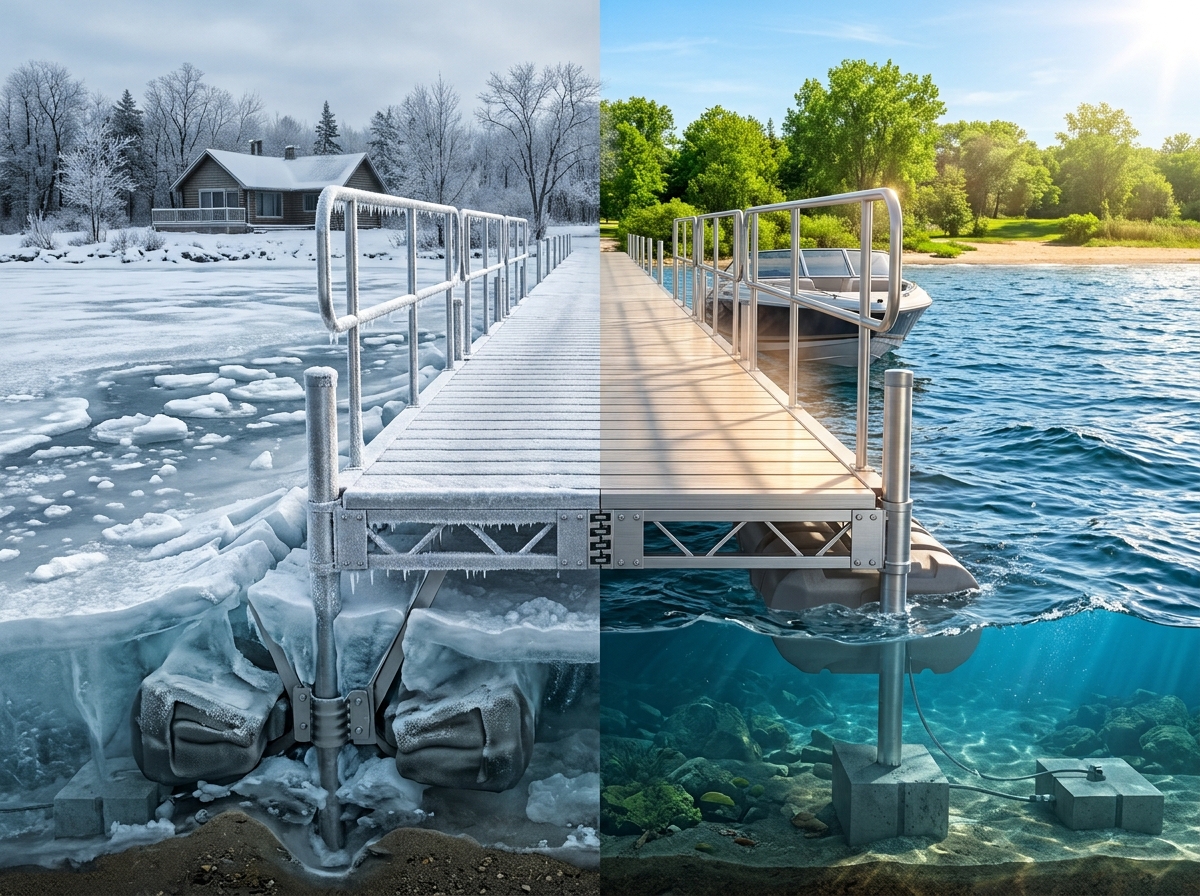
A dock can see a hot afternoon, a cold front, heavy wind, and a sharp water-level change within the same season. Those swings put stress on frames, joints, decking, and anchoring. Modern aluminum docks deal with that stress through material behavior and good engineering. The metal still expands, contracts, flexes, and reacts to load, but a properly designed system gives those forces somewhere to go.
Why Modern Aluminum Docks Don’t Warp When Winter Hits out of Nowhere
Aluminum changes size as temperatures fall, but normal thermal contraction happens across the material rather than at one random spot. A well-built frame uses bracing, sound welds, and connections that keep the structure aligned while allowing small dimensional changes.
Problems are more likely when a dock is poorly supported or locked too rigidly against another structure. Experienced floating dock builders account for movement at hinges, gangways, and anchor points so the frame is not fighting every temperature shift.
How Thermal Expansion Works on Aluminum Docks
Aluminum expands when it warms and contracts when it cools. On a long dock, those changes add up across the frame. That does not mean the dock should buckle or pull itself apart.
Joints, hinges, sliding points, and other connections can accommodate small changes in length. A boat dock builder also has to avoid hard connection points that prevent movement altogether. The goal is controlled movement, not a structure that is completely rigid.
What Sudden 40-Degree Temperature Drops Actually Do to Metal Dock Frames
A fast temperature drop causes the metal to cool and contract. Different components can cool at different rates depending on exposure, thickness, and whether they are above or below the waterline.
The bigger issue is restraint. If one part can move while another is fixed solidly, stress can collect around joints or attachments. Good fabrication and a sensible layout help spread that stress through the structure instead of concentrating it at one connection.
Why Marine-grade Aluminum Handles Freeze-thaw Cycles Way Better than Wood or Steel
Aluminum has a natural oxide layer that helps protect it from corrosion, and it does not absorb water like wood. That means it avoids the moisture-related swelling and decay concerns that can affect wood framing. Unlike unprotected carbon steel, it also does not form red rust.
That does not make an aluminum dock immune to damage. Hardware compatibility, drainage, coatings, weld quality, and routine inspection still matter. Buyers comparing aluminum docks should look at the whole system rather than judging durability by the frame material alone.
How Modern Aluminum Docks Take a Beating from Crazy Wave Chop and Wind
Wind and short, steep wave chop create repeated loading. A floating dock rises, falls, twists, and pulls against its anchors as that energy reaches the structure. Stiffness is useful, but too much rigidity can push loads into a few connection points.
An aluminum floating dock handles these forces best when the frame, floats, hinges, and anchoring system work together. The dock needs enough structure to stay aligned while still allowing the controlled movement expected on open water.
The Actual Science Behind Why Aluminum Docks Don’t Buckle in Extreme Summer Heat
Heat alone does not make a properly designed aluminum dock suddenly buckle. Buckling occurs when a structural member is placed under enough compressive force and cannot move or distribute that load safely.
That is why bracing, member shape, spacing, and connection design matter. Thermal expansion needs room to occur. Floating dock builders also account for surfaces heated by direct sun, since parts of a dock can become warmer than the surrounding air.
What Keeps Aluminum Floating Docks Intact When Water Levels Swing Wildly Overnight
Rapid water-level changes mainly challenge anchoring and access. A floating dock rises and falls with the water, but piles, cables, chains, or other anchoring components have to allow vertical travel without letting the dock drift too far sideways.
A gangway can also sit at a very different angle after a major rise or drop. Owners shopping for aluminum boat docks for sale should ask how a system handles that movement before focusing on appearance or accessories.
Cold snaps, summer heat, wind, and changing water are exactly the conditions that reveal whether dock design has been thought through. For owners researching an all-aluminum system, Flotation Systems Inc. offers residential and commercial dock configurations along with anchoring solutions, ramps, gangways, and LockDry® aluminum decking. Those details give buyers useful points to compare against the demands of their own shoreline.